english

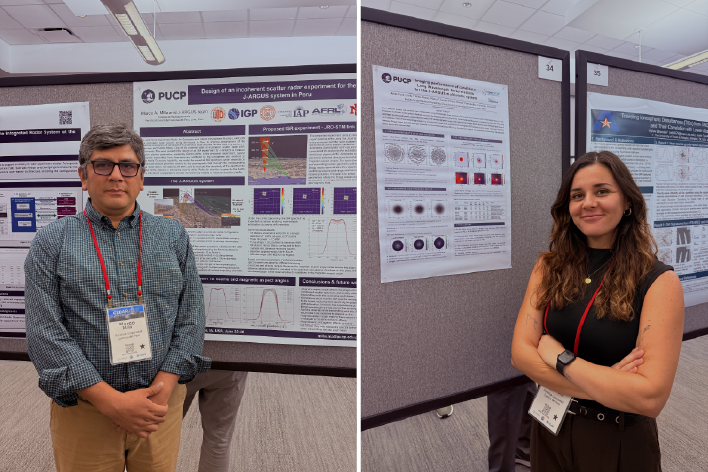
The Institute for Radio Astronomy of the Pontifical Catholic University of Peru (INRAS-PUCP) participated in the 2026 NSF CEDAR Workshop, held from June 21 to 26, 2026, in Des Moines, Iowa, USA. This annual scientific meeting brings together researchers in upper atmosphere, ionosphere, and geospace sciences to share research advances and strengthen collaboration among institutions.
During the workshop, Dr. Marco Milla, Director of INRAS-PUCP, and Dr. Carla Arce, researcher at INRAS-PUCP, presented two scientific posters related to the J-ARGUS system, contributing to the exchange of knowledge with researchers from universities and research institutions around the world.
Dr. Marco Milla presented the poster "Design of an Incoherent Scatter Radar Experiment for the J-ARGUS System in Peru". This research evaluates the feasibility of measuring ionospheric plasma parameters, with particular emphasis on estimating plasma drift velocities, providing key information to strengthen ionospheric observation capabilities in Peru.
Dr. Carla Arce presented the poster "Imaging Performance of Candidate Long Wavelength Array Stations for the J-ARGUS Multistatic System". This study evaluates candidate configurations for the future J-ARGUS stations at the PUCP Santa María Campus and Huancayo, as part of the design and implementation of this future radio astronomy network in Peru.
In addition to presenting both studies, the workshop provided an opportunity to exchange experiences with researchers from around the world, learn about recent advances in geospace sciences, and strengthen international scientific collaborations.
INRAS-PUCP's participation in the 2026 NSF CEDAR Workshop helped showcase the Institute's research on the J-ARGUS system, fostering scientific exchange with the international community and contributing to the advancement of radio astronomy and ionospheric research in Peru.